Sunday, October 6, 2013

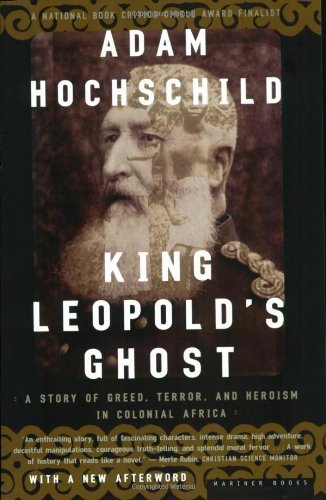
King Leopold's Ghost: A Story of Greed, Terror, and Heroism in Colonial Africa by Adam Hochschild - 366 Pages


Years ago, I remember while on a morning walk in Queen Elizabeth National Park in Uganda, watching off in the distance as the morning mist rolled in over Mount Stanley, part of the mountain range that makes up the border between Uganda and the Democratic Republic of Congo.  During my time in Uganda I had heard many stories for the first time about the spiritual, political, and social darkness as well as the amazing beauty and people of that massive country.  As I stood there taking in the beauty and mystery of the scene, I felt that whatever the future brought, the DRC would be part of it.  Originally I thought that call was a call to pursue missions in the DRC.  This seemed to be confirmed when the church I was working at in Los Angeles began to share our building with a congregation of dear Congolese brethren, many of whom where recent refugees from DRC.

For the time being it does not look like God is is leading us to live and work in DRC.  However, we believe that He has called us to be involved with DRC in a much more intimate way.  We are in the process of adopting two twins from DRC and making them part of our family.  That is another story in itself, one that you can follow here.

As God has kept DRC on our mind and heart, now is making it part of our family, Sarah and I have begun to look for resources to help us understand the history and culture of this vast country.  That's where King Leopold's Ghost comes in.

It's hard to know where to start in praising this book.  Although a work of historical nonfiction, it reads like a thriller.  It would be a fantastically entertaining story...if it weren't true.  You couldn't make up some of these characters - A heroic, homosexual with an English Bulldog, a Baptist missionary, an obese slimy lawyer, Mark Twain, Joseph Conrad, countless (literally) African victims, Parisian courtesans - the list goes on and on.

In reality it is truly haunting.  The extent to which this one man was able to exploit such a vast population and area is horrifying.  Yet it is in understanding this history that one begins to understand how such instability and corruption exists in the region today.  I do need to say that Hochschild, while focusing on the depravity of King Leopold and the type of people his exploitative rule attracted, doesn't gloss over the depravity of the other parties - African, Arab, and American alike.  However the extent to which Leopold oppressed the people of the Congo has few parallels in the history of injustice.

This book hit me in a personal place. These are people I know.  Now through adoption, these are people I am related to.  It is one thing to read about atrocities that happened in an exotic far away place in a time very different from our own.  It is quite another to read about your kids great - great -grandparents being treated like animals, and to see your kids living in the fallout of racist, imperialistic, systematic explotation today.

This is one of the best and most important books I have read in a long time.  I highly recommend it.


Saturday, October 5, 2013

Dispensationalism: Essential Beliefs and Common Myths by Michael J. Vlach - 73 pages


Great, short survey of Dispensationalist core assertions and common misunderstandings.  A great introduction not only to this eschatological view, but also to hermeneutics.  Any productive conversation about eschatology needs to start by truly understanding the views represented in the discussion and this concise book lays a great foundation for understanding what Dispensationalists believe.

Recommended as a good starting point for adherents and challengers of Dispensationalism alike.

Sanctification in the Everyday by John Piper - 50 pages


Three classic Piper sermons on the subject of sanctification in e-book form.  Great, soul-feeding truth.  Get it free here!

"...in every case, the decisive impulse for our holiness and our sin-killing is the death of Christ.  Which means that the decisive power for our conquering sin is Christ's canceling sin.  That is, the only sin that we can defeat is a forgiven sin."

"By the world's standards we may accomplish much without Christ (like build an institution, or produce a blockbuster movie).  But from God's perspective, without Christ our lives are like little, shriveled, fruitless twigs."

"Sin can't enslave a person who is utterly confident and sure and hope-filled in the infinite happiness of life with Christ in the future."

When God Comes Calling by Ted Fletcher - 172 pages


Good Missionary biographies are at once engrossing and instructive.  When God Comes Calling excels at both.  It starts out as an autobiography by Ted Fletcher, the founder of Pioneers, a missions agency that seeks to bring the Gospel the least reached and most inaccessible people groups on earth.  Fletcher tells about hearing the Gospel on the front lines of the Korean War as a Recon Marine.  After the war Fletcher became one of the senior editors of the Wall Street Journal.  Yet in all of that success, he and his wife Peggy, felt a call to be part of something more eternally significant.  After years of being rejected by traditional missionary agencies, they decided to start their own - Pioneers.

In the second half of the book, Fletcher leaves his story behind and instead tells of the amazing things God has done through Pioneers.  I found it instructive that even in his autobiography Fletcher rarely talked about himself, but wrote about the men and women of Pioneers, those who have come to faith through their work, and above all - His Savior.

The last chapter is a beautiful tribute to Ted, and God's work in and through him written by his wife Peggy.

Sarah and I hope to join Pioneers this year in preparation for missions work in Southeast Asia.  This book has confirmed that this agency has a Christ-centered, Gospel-driven ethos and we look forward of becoming a small part of the faithful legacy that God has given the Fletchers.

Tuesday, September 3, 2013

Amazing Diving Stories by John Bantin - 276 pages


This is a collection of exactly what the title says - Amazing Dive Stories.  Each story being only 5-6 pages long,  anyone remotely interested in diving will move quickly through the fascinating stories of underwater creature encounters (both friendly and not-so friendly), wreck dives, discovered treasure, triumph, and tragedy.  My only two critiques are: (1) the writing is a bit off, perhaps because of the British colloquialisms of the author, but I think it extends beyond this a bit.  (2) for whatever reason the stories got progressively macabre as the book progressed. This made for interesting reading but I think gave the book and diving in general an unfairly dark outlook.


Thursday, July 18, 2013

Timeline by Michael Crichton - 512 Pages


Archaeologists travel to Medieval Times and almost get stuck.  I would say that they time travel, but the book is very clear that what they are doing is not traveling through time but traveling to another, parallel universe.  Using pop quantum theory, Crichton has his adventurers basically getting faxed into a universe that is almost the same as ours, yet not the same.  Although Crichton's explanation is slightly more technical, you can understand that it is still quite a stretch and leaves ample room for some ridiculousness and plot holes - the biggest of which (in my opinion) is how does doing something in the past of one universe affect anything in the present of this universe...if they aren't the same universe?

Anyways, if you are willing to swallow some of the inevitable jumps in logic surrounding the time/universe travel, this is a fun, exciting read.  Nonstop action, most of the main characters are well developed and as a history buff I enjoyed the discussions on the importance and impact of understanding the history that has shaped the present.  

If you like Crichton, I think you would enjoy this, one of his less popular books.

Renting the movie this weekend.  Paul Walker is in it.  I have a very bad feeling about this....


Sunday, July 7, 2013

Foucault's Pendulum by Umberto Eco - 641 pages


I was thoroughly unimpressed with this book.


Imagine 40 pages of a Dan Brown novel (although admittedly Eco's prose is much more refined and beautiful than Brown's) bookending 600 pages of three guys sitting around talking about conspiracy theories, secret societies, pseudo-history, occult rituals, mysticism and abstract dream sequences.


I'm sure some English major types would like the whole everything-relates-to-everything-and-words-have-whatever-meaning-we-assign-to-them-reality-is-what-we-make-it postmodern subthemes that run through the book. No thanks.


as reviewers on goodreads commented:


"One of those books where the author tediously says next to nothing, and all the semi-litterati can't figure out what he's trying to say, so they conclude he must be brilliant."


or


"This book consists of predominantly two things: (1) Endless dialogue by mentally unbalanced paranoid conspiracy theorists; (2) Endless dialogue by scholars who study mentally unbalanced paranoid conspiracy theorists. This is not a bad book, but its not an easy read, and not really a particularly enjoyable one."


If you want to read about postmodern philosophy I would suggest not Foucault's Pendulum but Michel Foucault. Likewise, if you want to read a thriller about Rosicrucians and Templars and the like I would look elsewhere.